Tully Ryan | IQExit
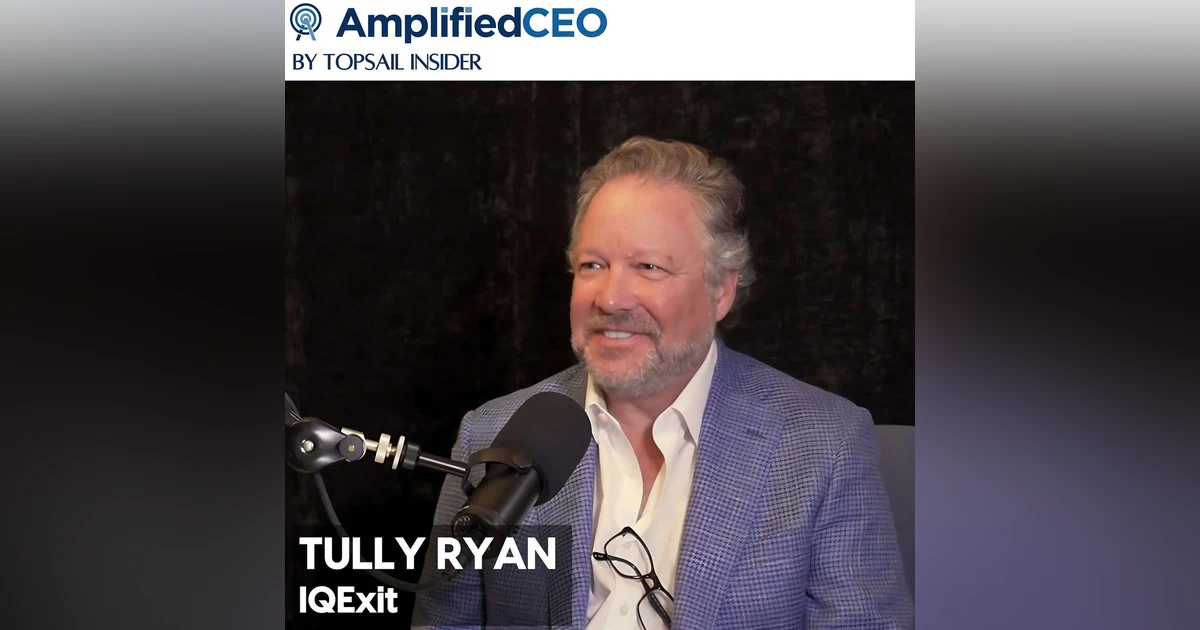


In this episode of Amplified CEO, Richard Stroupe sits down with Tully Ryan, CEO of IQExit and Managing Director at Murphy Business, as well as a contributor to the Wilmington Business Journal.
Tully shares his journey from launching a tech company during the dot-com era to advising founder-led businesses on growth, transition planning, and successful exits in today’s evolving M&A market.
The conversation explores AI’s impact on business operations, acquisition entrepreneurship, private equity trends, and the coming “Silver Tsunami” of business owners preparing to transition or sell their companies over the next decade.
Richard and Tully also discuss why so many deals fail before closing — from unrealistic valuations and customer concentration to poor succession planning and lack of diligence readiness — and why business owners should begin preparing years before they intend to exit.
For founders, operators, advisors, and entrepreneurs interested in business growth, acquisitions, or exit strategy, this episode offers a practical look at what creates long-term enterprise value and successful transitions.
Connect with Tully Ryan:
• IQExit: https://www.iqexit.com/
• Murphy Business / Carolina Business Broker: https://carolinabusinessbroker.com/
• Wilmington Business Journal: https://www.wilmingtonbiz.com/insights/tullyryan/318
• LinkedIn: https://www.linkedin.com/in/tully-ryan-93137268/
Send us a text. Leave your phone number if you'd like a reply. Thanks!
Co-Produced by Topsail Insider and Cape Fear Ventures
Edited by Coastal Carolina Network
To learn more about Amplified CEO, visit www.topsailinsider.com/aceo
To learn more about Topsail Insider, visit www.topsailinsider.com.
To learn more about Richard Stroupe, or Cape Fear Ventures, please contact Christa at (910) 800-0111 or christa@topsailinsider.com.
Amplified CEO - Tully Ryan - IQExit
[00:00:00] Intro/Outro: Welcome to The Amplified CEO with VC and serial entrepreneur Richard Stroupe. You know? Yeah, but you build a legacy around one game, like- Well- ... 12, 20 years ago But, you know, when, when you're at a school like w- where, where we went, you only have so many opportunities. Yeah. I mean, think about it. Most of our games are if you win it, okay.
[00:00:23] Richard: Yeah. But you don't have that many times to make a statement. Right. So. No, you're right. I'm all, I'm all for it. Yeah, East Carolina actually recruited me as well. They were the only Division I school that recruited me. I had all D2s and a couple junior colleges, but yeah. But of course my dad, I remember sp- you know, specifically, I was talking to my dad- Yeah
[00:00:43] Tully: about this and, uh, he's like, "There is no way in hell you're gonna go to East Carolina." Yeah. It's like, "No- Yeah ... this is not startup." Because of, don't say Halloween. No, no, because, you know, he felt like it was a party school and I would- Yeah ... you know, lose myself. You know, it's, it's interesting because it probably is considered that, uh, for many reasons, but mostly because of Playboy in their, you know, in their marketing campaign that we were- Yeah
[00:01:08] we weren't just a party school, but we were above most schools 'cause we took grad- graduate level partying classes, I guess. Mm-hmm. But, uh, um, and it still haunts us today, to be honest- Mm ... with you. I mean, we have a... I mean, the medical school's second to none. Mm-hmm. I think the business school, if you look what, you know, um, folks that came out of there, is incredible.
[00:01:28] Richard: Right. But it just has that reputation unfortunately. Yeah. You know? Yeah. It's, it's... You know, undergrad, it's the second largest school in the state. Correct. Yeah. Yeah. Yeah, the campus is huge. It's beautiful too. Yeah. People don't really realize it. Yeah. You know? Yeah. So, uh, but yeah, I'm proud of it. Um, I went to ECU.
[00:01:48] My daughter went to ECU and got a master's in, as a, as accountant and works with RSM. My son went to ECU. They both graduated in the business school, and he was at CapTrust, and he just recently left to go do his entrepreneurial thing. Okay. So, uh, but, uh, yeah, really, really proud of that. So when did you get in- involved?
[00:02:08] You know, after, you know, as far as the, the board of visitors and- Well, I, I... You know, let's don't quote the year, uh, because I can't remember the year. Yeah. But it was probably 10, 15 years ago. Okay. I was asked to sit on the b- board of visitors, and, uh, rose through. I was vice chairman of that board for a while.
[00:02:27] Mm-hmm. And, uh, but then, you know, I just, um, I felt like I needed to focus on other things. I mean, you just, you can't spread it too thin. Well, it's very time-consuming- Yeah ... right? Yeah. Yeah. But- I was on the, the board of advisors- Mm-hmm ... for Appalachian State College of Business. Mm-hmm. Not the, the board of visitors- Right
[00:02:45] but, um, but even there, you know, you're trying to help them with the curriculum and give them perspective of- Yeah ... how industry is evolving and what, what s- skills they're looking for- Mm-hmm ... to help. You know, ultimately we're trying to help m- find- kids' jobs- Yeah ... and, and place them in- into industry and prepare them, uh, as best we can.
[00:03:06] Uh, and there's always a mismatch- Yeah ... uh, between where academia is at and then where industry is. And, and usually the curve is not too bad, 'cause you're- Not too bad, but industry's always ahead, right? So- Not, not like now. I mean- You think? Yeah, yeah. I w- I was having a conversation with a friend of mine at App State about this.
[00:03:27] You know, I, I told her, I said, "There's always kinda been a gap-" Mm-hmm ... where you could, you could defend and say academia is providing foundational skills. Mm-hmm. Um, not the technical skills that you need in the industry, but it gives you the ability to take those skills on and come up to speed pretty quickly, but at least you've got the foundation.
[00:03:47] Yeah. You know, the math, the sciences, the communications, and, you know, even some of the IT stuff. It's just foundational knowledge. Yeah. Um, but now I kinda feel like with AI and, and how disruptive it's becoming, uh, that gap is, is widening much faster than ever. Yeah. And, and I'm not sure academia knows what to do about it.
[00:04:10] Tully: Well, that's, that's my point- Yeah ... is there's, it's, it's, you know, we gotta get back to the basics, and that is kids, and even us at 50 some odd years old, right? We gotta think back to solving problems. Mm-hmm. How do we solve problems? Mm. And certainly AI is, you know, can, can help with that. But, you know, we're not AI.
[00:04:33] You know, there's not a, there's only about a handful of AI companies out there. Right. But we can all use AI to enhance what we're doing. I spoke with a, um, a, a business owner that I sold his, the business t- to him. Mm. And, uh, he's in South Carolina. It's a telecom, great telecom business, and he was telling me this morning how he was using AI to build in efficiencies, and he's making just as much profit on the smaller deals as he is on the, the big deals.
[00:05:02] Right. And that made me so happy, you know, t- t- for a, you know, a company that is just wiring and doing this, you know, trenching and things like that. Yeah, yeah. Using AI to, you know, build efficiencies and it's, it's amazing, you know? Yeah. So now, with that being said, I, you know, full transparency, this guy came from AWS, Amazon- Yeah
[00:05:22] Web Services, right? So he, he knew what he's doing. So he knew, yeah, he knew, he knew the, the, the thing. But, uh- Mm ... but it's still pretty impressive what- Oh, for sure ... what, what folks are doing out there. Yeah, it's a double-edged sword, right? Yeah. I mean, because we talk about invoking efficiencies- Mm-hmm ... and, and, and building in workflows and automation.
[00:05:40] But ultimately, one of the most expensive aspects of that model is labor. Mm-hmm. So if you're automating workflows, you, then you're removing human interactions that help automate the workflows. Um- It's just, it's... They need to be more creative about it. I mean, AI is very powerful. And instead of, you know, looking for ways to be efficient by- Mm-hmm
[00:06:04] cutting resources- Mm-hmm ... they should focus on being creative, on expanding opportunities, expanding business models- Mm-hmm ... expanding resources so that individuals don't feel like they're being displaced. Right. More or less, they feel like they're being complimented- Right ... you know, by, by another coworker, you know, s- so to speak- Yeah
[00:06:23] Richard: and, and still being able to, to enable their job be successful. A coworker or five. Yeah. Right? Yeah. Right. Yeah. I mean, I think that's a conversation within the conversation, and, you know, with your background in venture capital, you know, you've gotta be looking at it from a different lens altogether. How is this gonna disrupt some of the stuff that you're doing?
[00:06:42] Yeah. You know, how much money is gonna need to be raised? Because back in the day, I hate saying that word, you know, that phrase- Mm-hmm ... but, um, y- you know, I kinda went through it 10, 15 years ago myself- Mm-hmm ... raising capital, and it was all about, yeah, some, you know, some equipment and FF&E and marketing and all that, but it was mostly because you wanted to hire a team, you know, whether it's, you know, H- you know, through HR- Mm-hmm
[00:07:06] a team for programmers or team for sales and so forth. And now with AI, do you need that, or do you need as many? Right. And that's what's gonna be really fascinating over the next... I mean, it's a great time to, you know, we're both lucky to be in it right now because it is the, kind of the, the plate is clean in a way.
[00:07:24] Tully: Right. You know? And you can think about problems, and then think about solving those problems in a different, you know, kind of in a different context. Mm-hmm. I mean, it kinda gets back, I know we don't wanna get into this right now, but, uh, IQ Exit would never, we, I would never be able to do this without AI.
[00:07:39] Mm-hmm. But we're not a AI company. Right. But you- You know? ... you use AI to enable the operations- Absolutely ... yeah, to scale. We use AI. Yeah. And, and w- we're able to use AI to scale. Yeah. You know? Yeah. And what we're doing is a little bit different. Mm-hmm. Uh, but we're able to do it To scale. Mm-hmm. And that's what makes it...
[00:07:56] Richard: That's, that's what makes it work. Right, yeah. So kind of exciting. So, yeah, tell me about your journey before s- you know, getting into the details of your current venture. Uh, I'd love to learn more about that and understand- Yeah ... the market and what you're seeing, you know, for helping some of your clients, but.
[00:08:11] Tully: Well, I, I mean, I, I developed IQ Exit through the lens of, uh, business brokerage and M&A and, and, um, but it didn't really start there. Mm-hmm. You know, there was a, there was a journey before that, right? Oh, yeah. Yeah. So much like your audience, I, you know, I'm, I'm still interested in building something. And, uh, so I've always been a serial entrepreneur.
[00:08:32] Um, uh, started my first company in 1997. I know that s- seems a while ago. Mm-hmm. Um, but, uh, um, I was working in the environmental field. I'm a geologist by, by training. Okay. And, uh, so I was traveling pretty much during the week, and then I would get home on Friday and sit in the office until Friday, oh, dark 30.
[00:08:55] And, and sending out, back in the days, faxes, you know, requests for proposals, requests for information, and, and so forth for two or three weeks ahead of time. Mm-hmm. And I just felt like there was a better way to do it, and that's when the internet was coming about. And so we put all of that... I, I teamed up with a, uh, uh, with a gentleman, uh, that used to work for Northern Telecom- Mm-hmm
[00:09:17] which doesn't exist anymore. Right. But, uh, I'm, I'm aging myself. But, uh, we started a little business in a third bedroom, and it kinda blossomed, and I, I raised capital out of, uh, Boston and, uh, um, moved the business from Raleigh to Boston- Yeah ... uh, for a few years. That's always the, the ask. Yes, it is. Take our money, but live in our backyard.
[00:09:37] Yes. Yeah. So, um, so it was kind of a pre-Shark Tank thing. I, I went up there. I, I didn't even know what an angel investor was, didn't really have a business plan. I just knew it worked- Mm-hmm ... and we were scaling. And, uh, and met some folks up there. Um, and, uh, they kinda put a team around me- Mm-hmm ... and we built a, a business.
[00:09:57] It was a pr- it was a basically a, a procurement solution- Okay ... online procurement solution. We were focused on, uh, engineering and environmental companies. Mm-hmm. And, um, but w- what was significant about that in my journey is I was, um, introduced to the, my chairman at the time, and he was... He kinda led the investment round, uh, Ed Fredkin.
[00:10:18] Mm-hmm. And Ed was the, uh, basically the director of the Artificial Intelligence Lab at MIT. Mm-hmm. And so he st- started talking about this stuff 25, 30 years ago, and I had no idea what the heck he was talking about, but he was just a, a real brilliant man. He, he passed away about a year or so ago. But I learned a lot from him and, uh, and he brought in our first chief technical officer- Mm-hmm
[00:10:44] and his name was Victor Briaverin. And Victor's claim to fame was he was Gorbachev's- uh, director, um, his chief technical officer when Gorbachev was the director of ag- agriculture before he became premier in, in Russia. Mm-hmm. And Ed recruited, uh, Victor over to, uh, to teach at MIT. But before doing that, when he was in Russia, he developed the computer game Tetris.
[00:11:08] Interesting. And so that was a real easy in. I was up... You know, we were doing enterprise sales, but I would always, you know, lead in, "We've got Victor Bryakorin as our chief technical officer," and Tetris, and- Yeah ... and it was just like, "Oh, welcome." Mm-hmm. So that was, uh... So I was, I was surrounded by some really, really smart people.
[00:11:28] Richard: And, and of course, there was more than that, uh, around. But, uh, that kind of got me into never thought about starting a business, and, uh, but solving problems, and that's how my journey kind of started. Um- Did you raise capital from a VC or an angel, or who was it in Boston? We did. We, we, we raised capital through angel- Mm-hmm
[00:11:46] Tully: um, mostly. Big angels. Mm-hmm. Um- And they had a demand that you move up to Boston? Well, uh, yes. So they wanted to put a... I was 27 years old at the time with a geo- with a geology degree. Yeah. Right? Yeah. So they wanted to put a management team in place, so, um, one of the demands was I move up to Newton Center- Mm-hmm
[00:12:05] Massachusetts, uh, which was only three T stops to Fenway Park. Right. And that was really nice. Yeah. But, uh, but yeah, I was up there for two and a half years, and we eventually moved the business, uh, from there to, uh, uh, to Edenton. Mm-hmm. And, uh, during the dot-com crash. And, uh, we had a glass palace up there that, uh, we decided we didn't need anymore, so we, we moved down to Edenton.
[00:12:31] Yeah. Yeah. So I- Okay ... kind of got back into my roots. Right. Yeah. Yeah. Up there, I could hear my own accent. Yes. You know, when I moved down here- Yeah ... I was like, "Okay, I'm back." Yeah. Yeah. Yeah. I've spent some time up there. Mm-hmm. And my daughter goes to school there right now, but- Mm-hmm. But Boston's great.
[00:12:46] Richard: Great place. Yeah. Yeah. Yeah, just not in the wintertime. No, I... And I am a Eastern North Carolina guy- Yeah ... through and through- Yeah ... so I don't wear socks. Oh, okay. And I, I, uh, for whatever reason, I didn't wear socks up there, and it was a little brutal at times. There's a reason why there's underground tunnels at Harvard.
[00:13:04] Yeah, yeah. Yeah. Yeah, so. Um, yeah, you spoke about Fenway. That's, like, one of the best ballparks to- Unbelievable. Yeah. Unbelievable. Um- We were talking about Camden Yards yesterday. We had a guest on who was from Baltimore area, and- Another great ballpark ... Camden's beautiful. Yeah. But, like- Yeah ... Fenway is just- Fenway-
[00:13:20] unique ... you, you can smell it. Yeah. You know? Yeah. It's, it's like- And, um- Yeah ... we would, after work, uh, sometimes we would just jump on the T and see if we can get tickets. And I remember, this is gonna date me as well, but I remember, um, a buddy of mine, a coworker of mine, we went and, and scalped two tickets- And we didn't know where they were.
[00:13:40] It didn't really matter- Mm-hmm ... at the time. But we looked at them and we were like, "These look like pretty good seats." They were second row behind home plate- Wow ... when, um, Pedro Martinez was pitching. Wow. And they were playing the, uh, the Montreal Expos, I think it, I think it was. Mm-hmm. Or maybe it was the Blue Jays, one of the Canadian teams.
[00:13:58] Mm-hmm. And it was unbelievable 'cause y- everybody's seen him somewhere on YouTube or whatever pitching. Yeah. But his balls would move so much- Yeah ... that the guys would truly be bailing out. Yeah. It was amazing. Yeah. And he had that little mean streak anyway. Oh, yeah. But it was a- Yeah ... incredible... And, and really anywhere you sat in that ballpark was a, a phenomenal seat.
[00:14:17] Yeah, yeah. Yeah. For sure. So. Yeah, that's great. It was, it was good. So, so how long did you stay in Boston before you moved back to North Carolina? We were... I raised money in, uh, it was probably about two and a half, three years. Okay. But I didn't really spend a whole lot of time in Boston. It was those days that you were on a plane two and three times- Okay
[00:14:35] Tully: a w- a, you know, a week basically. Yeah. And we were doing, uh, strategic deals, partnerships. Um, you know, we were... I was working with Microsoft, Yahoo, you know, on their campuses and- Mm-hmm ... and so forth out there. So that gave me really, uh, unbelievable exposure- Mm-hmm ... uh, going out there. But, uh, we were, you know, we were just, you know, we were m- we were everywhere- Mm-hmm
[00:14:59] Richard: it seemed like. And, uh, a lot of energy and, uh, we were in California one day and then, excuse me, Texas the next, it seemed like. Right. So we were just hustling. Mm-hmm. And that's what it takes. Oh, yeah. And I think- Yeah ... a lot of folks, um, you know, it comes easy for some- Mm-hmm ... but a lot of times it just, it takes that.
[00:15:19] Yeah. You know? Yeah, I can imagine that experience being a young man, because as you mentioned, surrounding yourself with very smart people- Mm-hmm ... and absorbing their energy and trying to understand exactly why they do how they do it, and how that can be applied to your business model- Mm-hmm ... and, and to scale operations, it's, it's a unique experience for sure.
[00:15:40] Tully: It, it really was. Yeah, yeah. And I, I don't think I could be doing what I'm doing today- Mm-hmm ... even on the business brokerage side without that experience. Right. Because, you know, I'm able to relate to the business owners- Yeah ... uh, a little bit more in what their, their journey- Mm-hmm ... is like and was like.
[00:15:54] So did you exit from that company or, uh, did you sell it? Or what was the strategy? Well, we've had... So, so that company started, um, you know, as a one product company. Mm-hmm. But when we moved down to Edenton, what was really interesting was, you know, we were a, a big fish in a small pond. Mm-hmm. And so there's not many technology companies, and s- back then Wilmington isn't really what it was, is today.
[00:16:16] Yeah. And so we were a big- little technology company in Edenton in eastern North Carolina. So we were having folks, um, you know, coming to us and saying, "Hey, I've got this idea. Can you create it or develop it?" Mm-hmm. And so we, um, you know, we kind of diversified a little bit, and we almost became not a venture technology...
[00:16:37] Well, we were more like a venture technology company, where we would partner up if we felt like there was an opportunity with entrepreneurs that had this idea, that had this vision. Mm-hmm. And, uh, and then they needed us to create whatever it was, and then we would actually go out and raise capital for them.
[00:16:53] We would put together the business plan. We'd, you know, pro forma and, and the technology, and we would... We started, you know, three or four different ventures that way. Wow, interesting. And so that's where I got into the banking side of things. Yeah. And, and again, um, we developed POS solutions- Mm-hmm ... and it was just, it, you know, it was, it was, it was, it was, it was fun.
[00:17:13] Did you earn equity for that work, or was it more just of a fee, fee-based? Well, what we did, um, was we developed wh- whoever the, the, you know, the entrepreneur that came w- in with the idea- Mm-hmm ... we'd create a, a separate entity. Mm. And so, yes, the, uh, the company had equity, and I certainly, I had c- I, we had a company called Broad Street Software Group.
[00:17:33] Okay. And that had equity in the, in the business. And then, uh, and then we all had... You know, my f- my partners would have, um, equity in Broad Street. Yeah. Yeah. Yeah, that's a great model. Does that make sense? Yeah, absolutely. Yeah, yeah. Um, does that still exist or, or- No, we, we disbanded that. Um, and, uh, so probably a, I guess a little over 10 years ago, I, I was kinda burned out with the startups- Mm
[00:17:57] and raising capital and doing all the things that you have to do. And, and, uh, so I kinda pivoted, and I had a investor that had a small boutique M&A firm in Virginia. Mm-hmm. And he was telling me for a few years that, you know, I'd be perfect doing M&As, you know? Mm-hmm. And so I dipped my toe into it and, um, found that I was pretty successful doing it.
[00:18:21] Um, you know, I was pitching companies that had no revenue, no P&L, no balance sheet, right? Yeah. To, to pitching companies that were, you know, very successful- Mm-hmm ... and, uh, and had a real enterprise value. Mm-hmm. And so it was a very easy transition, so I've been doing M&A for, for about 10 years now. Okay.
[00:18:40] Richard: Yeah. So to, did you have to go back and get any kind of training, like, for- Abs- yeah, abs- ... investment banking or Series 7? Yeah, abs- abs- Well, I didn't have to do that. Okay. Um, so but I had to go back and learn how to evaluate businesses and- Yeah, like discounted cash flow- ... put to- uh, discount cash flow ... yeah And by the way, that's the hardest thing ever.
[00:18:58] Tully: I don't even- Yeah ... do that You know, so it's, it's a total skill. You know, I'd have to go to Wake Forest and get my MBA or something to- No ... to do that. No. But I have folks that can do that. So, um, so yeah, so that... And it's been a great experience meeting a lot of entrepreneurs and, and really looking under the hood of so many businesses- Mm-hmm
[00:19:16] and see how they're run. Yeah. And the other thing, Richard, that I really enjoy doing is not just looking at the business and the financials, but really looking at the, the business's, their, their culture. Mm-hmm. And that gets me excited- Right ... is, is the culture. Yeah. So, uh... And I kinda put two and two together.
[00:19:33] Richard: You gotta have great books and you gotta, you know- Oh, yeah ... be profitable, but you also have- Mm ... to have that, that culture. And there's other things too that we look at- Yeah, yeah ... but certainly culture is really important. Yeah, yeah. I completed a class after I sold my first company. Like you, I got kind of addicted to the deal because there's a lot of moving parts.
[00:19:52] Mm-hmm. A lot of discussions and, uh, of course, the front porch of a deal is, you know, kind of exciting. Mm. Of course, the back porch is more of the transition. Yeah. And, you know, there's a anecdote. It said 90% of all M&A deals fail because of failure to execute transition. So it got me interested in it, and so I, I pitched the, the company that bought me.
[00:20:15] I said, "You know, if you're gonna continue doing deals, I'd like to be a part of that strategy." And they're like, "Yeah, that's a great idea." "Well, there's this class at University of Pennsylvania called M&A, Mergers and Acquisitions." Mm-hmm. "Can I take it?" And they're like, "Sure." Um, you know, and there was one full day where they talked about valuation.
[00:20:32] Mm-hmm. And the guy who wrote this book, I can't remember his name. Naveck probably. Yes. He was- I've, I've got it. It's called Valuation. Yeah, yeah. The name of the book. Yeah. Yeah. The guy who wrote it is a professor. He was there that day. Mm-hmm. And, um, and he talked about DCF and- Mm-hmm ... EBITDA, cash flow analysis- Mm
[00:20:50] and trying to, like, find a happy medium to kinda pick and- Mm-hmm ... you know, whenever I sold my first company, it was all based on EBITDA- Mm-hmm ... in government, go- contracting, GovCon. Mm-hmm. Um, and it's kinda like, um, you know, EBITDA multiples is kind of a shortcut. It kinda shows you some, how the business performs.
[00:21:11] However, it doesn't really show you truly. There's, there's s- there's some gaps in there- Mm ... and you have to, like, find those gaps, um. Well, that's due diligence. Yeah. In cash flows. Yeah, yeah. Yeah. Yeah, yeah, yeah. It's like, yeah. You may have a profitable EBITDA business, but your cash flow could be very poor.
[00:21:25] Right. Yeah. Right. So, um. Right. Yeah, we look at EBITDA and we also look at, in a, in a different term, but s- similar. I mean, you still have to recast the, the financials, but we- Yeah ... look at seller discretionary earnings. Mm. And keep in mind, the deals that I do are kinda below the investment banking You know, sector- Mm-hmm
[00:21:43] that are doing, you know, enterprise value businesses of 50 million and, and higher. Yeah. And, um, you know, the sweet spot that I have found for myself is that, you know, that $1 to $2 million up to that 25, $30 million range. Okay. There's really not that many, you know, people doing that. Right. Uh, you know, we do have business brokers out there and, and, uh, that are doing more Main Street-type businesses.
[00:22:09] Tully: Mm-hmm. Uh, but, uh, and that's kind of a crowded little space right there. Mm-hmm. But I've found my blue ocean, uh, in that, in that space between the business broker and the, uh- Yeah ... investment banking group. So what industries do you serve? I s- I do all of them. Okay. And really what I focus on isn't so much, um, I'm agnostic.
[00:22:27] Richard: It's not really so much on the industry, but w- what I focus on when I look at a business is who the s- who the seller, I mean who the buyer's going to be. Okay. And so I deal pretty much with private equity and strategic- So you're, you're more buy, buy side. No. Well, I have done buy side. Okay. Um, and, and that's, you know, that's something that I've done in the past.
[00:22:49] Tully: Um, but I'm mostly sell side. You're s- Okay. Yeah. But representing the seller, I know how to deal with private equity, and I know how to deal- Yeah ... with strategics because- Okay ... you know, you deal with them long enough, you know they're l- you know, y- you know the reason- Yeah ... for the deal structure. Yeah. You know the reason why there's rollover equity.
[00:23:04] Richard: You know the reason for earn out. It's not just, "Let's have one." Yeah. There's a reason behind it. Yeah. And as long as you know that reason, then it gives you kind of a leg up when you're negotiating it. Mm-hmm. And so that's kind of where I've kind of positioned myself. Okay. So you're mostly sell side.
[00:23:21] Mm-hmm. Perhaps a little bit of buy side in the past. Yeah, so, so- So these are, these are sellers of businesses that wish to exit. Yes. Okay. Yeah. And either to a strategic buyer or to private equity. You ever done an IPO or...? No. Okay. No, that's a, that's a wh- that's a JPMorgan thing. Okay. You know, I leave that to them.
[00:23:39] But, uh, no, I'm, I'm very focused on, on, on the exit- Okay ... and, and what I do. What, what size of companies, like revenue targets, do you mostly work with? Uh, right now, you know, it's, it's anywhere between 10 million to $30 million, $40 million- Okay ... in, in revenue. Okay. Yeah. And so basically that, that, that 50 million threshold is kind of what you like to stay underneath.
[00:24:02] Yes, because I don't want to compete with- Yeah ... the, the investment bankers. Is, that's the main reason. Yeah. It's not that we can't do it, but it's just- Yeah ... it's, it's about- Yeah ... my space. Um, I know when I sold back in 2009, I paid $375,000 as a, as a fee. Mm-hmm. And it was, the way they organized the fee, uh, I'm not gonna tell you who it is.
[00:24:29] Um- It's a big, it's a big bank. Mm-hmm. It's a, a investment bank. But we had a minimum Up to like a $15 million deal Mm-hmm And anything above 15 million, they got a percent, almost like a commission. Mm-hmm. Um, of course, we did hit the, you know, above the 15 million hurdle. Mm-hmm. Um, so when you add it all together, I think it started at 275, ended up at 375.
[00:24:52] But, um, what are, what are some of the fee structures? Or do you work on commission or ... Yeah. It's- You know ... it, it, we char- I charge a, a little retainer just so the- Just to get going ... well, not to get going, but to make sure the seller is committed. Committed. Right? Okay. Um, so you know, I just need him to write a little check, and it's not much.
[00:25:12] Tully: It's not much at all. And, uh, so the, the, the amount i- isn't the issue. It's just I want him to write a check- Yeah ... you know, along with signing the, the engagement letter. Yeah. But yes, the commission is, um, in the size that we're talking about, is, is a tiered approach. Mm-hmm. Um, and there's ... I use two types of commission and, and, uh, um, you know, it goes
[00:25:36] I, I don't really want to give out my trade secrets, but I will. Mm. Uh, so on smaller deals, smaller deals with deals that are below five million, it's 10% for the first million. Mm. Um, 8% for the second and 6% after that. Okay. So you can do the math. Mm-hmm. Anything above five million-ish, I will say, then what I was, what I charge is 5% for the first five million- Mm-hmm
[00:26:01] and then 4%, 3%, 2%, every five million increment. Yeah, yeah. And that's probably similar. Although, uh, uh, you know, when you get into the $100 million range, it will be a, you know, exactly- It's more ... what you said. Yeah. "Here's the minimum." Yeah. "If we get this- Yeah ... there's another 2% on the, you know, commission for the, you know, whatever it may be."
[00:26:21] Yeah. So there's a lot of different structures. I think for the size businesses that I'm dealing with, it's pretty standard. Mm-hmm. Um, the other thing too, uh, is every business has a real estate component to it. Mm. Right? So you know, the owner may own the real estate, so we sell the real estate with the business, and that's a separate transaction.
[00:26:41] Mm-hmm. Uh, so, uh, or, you know, if the seller doesn't own the real estate, there's a third party that holds the real estate. I've got to deal with the third party to make sure that we can get the new owner in with a, you know, with a lease- Mm-hmm ... that makes sense, typically, you know, the life of the loan, which is 10 years.
[00:26:58] Richard: Mm-hmm. So, uh, so there's a lot of, of, of that as well. So there's r- every deal there's two, basically two commissions. Yeah. And how long does it usually take for you to, to execute a deal? Is it three, four, six months or a little longer? Well, the larger deals- Mm ... um, where there's private equity and strategics, it's much quicker than that- Mm
[00:27:17] Tully: because we can do the research and we sort of know who the, quote-unquote, "buyers" will be, so we could target them. Okay. The smaller deals when you don't know who the buyer's going to be and it just sits out there until the right buyer walks down the street and, and sees it, um- It could take up to a year.
[00:27:34] Richard: Mm-hmm. So I try to set, you know, part of our job is to set expectations, right? Mm-hmm. Set, set an expectation of what the business can be sold for, how long it's going to take. Those are the two main things. Uh, but I like to set the expectation that it's going to take a year and, uh, but most likely it will be nine months.
[00:27:51] Mm-hmm. And typically we can get it done within six months. If everything goes well. And, and there's a lot of legwork, right? There's at least a couple months of prep work where- Yes ... you have to get your documents in order and- Yes ... then you have to get, create a book, as they call it. Yeah, a SIM. Confidential- A SIM.
[00:28:05] Yep. Yeah. Mm-hmm. So- That takes a bit of time ... that takes some time. Yeah. That takes some time. Um, collecting the information is what takes the time. Mm-hmm. You know, all the financials. Uh, we look at last three years of tax returns. We go back even further than that with P&Ls, monthly P&Ls, balance sheets. Um, you know, we
[00:28:23] Tully: Basically, the SIM is, in essence, a business plan- Mm ... that we write. Got it. That could be, in just a few s- strokes, could be turned into a business plan. Yeah. Uh, because that's what we're, that's what we're pitching. Mm-hmm. You know, we're pitching that company. Mm-hmm. Um, but, uh, yeah, there's a lot of work that goes into it, but it's needed because that's how I learn- Right
[00:28:42] about the business. Yeah. And so that's, you know ... So, you know, with my experience of pitching companies, I l- I can look at a business and say, basically to myself, "What could be done to make it better?" Mm-hmm. And so I ... You know, of course, you sell the business as is, what it is, and that's how you value the business.
[00:29:00] You're not really looking into the future l- like we do in s- startups. But what I also do, w- well, the way I look at it is, if the next business owner could do this, this or that- Mm-hmm ... then there's more opportunity there, and that's the way I kinda look at it. Mm-hmm. And that comes from the lens of working with startups.
[00:29:18] Richard: Right. You know? Yeah. So how many deals have you done overall? Um, over the 10 years, I will average five or six deals a year. Per year, okay. Some years are n- not, not that. Yeah. Some years are, you know, approaching that, I guess. Yeah. So, you know, over the last 10 years, I would say, you know, somewhere in the 40 to 50- Yeah
[00:29:39] range. That's, that's not bad. It's, it's a little bit of l- yeah. Yeah. It's a little bit of experience. I mean, if you're targeting five to 10 a year, that's, that's pretty healthy, I guess. Yeah. Well, not five to 10- Okay ... uh, deals a year, but- Yeah ... but, uh, um, you know, certainly five to six deals are within it. You know, r- this year, um, you know, probably five or six right now.
[00:29:58] Mm-hmm. And I think this year a- and going forward, and we're g- we'll talk a little bit about what's happening- Yeah ... in the market. But, uh, um, y- you know, there, there is a pipeline that, uh, that we've kinda developed and, and I, I see it happening, you know, the next two, three, four years- Mm-hmm ... actually. Yeah.
[00:30:15] Tully: What are some of the industry trends right now? What are you, what are you seeing in this, the hot markets? Well, there's a, there's, there's, there's a d- There's a, there's gonna be a big clash here real soon that nobody's really talking about. And so we've all heard about, you know, the demographics going on.
[00:30:28] You got the silver tsunami. Mm-hmm. And, uh, you know, um, you know, whether you're talking, you know, about McKinsey, you know, in their report that they published in February, they estimate 14, um, y- you know, well, six m- six million businesses are gonna need to change hands within the next, you know, decade.
[00:30:47] Mm-hmm. Representing $14 trillion of enterprise value- Mm-hmm ... there. But then in the market, y- you've, we've got a K-shaped market right now. Right. Because- Mm ... um, a lot of the sellers coming to market aren't prepared. Mm-hmm. For whatever reason. You know, messy books. Um, it's, it may be the owner is doing everything, so there's no transition.
[00:31:08] There's not even an opportunity to have a m- a management team behind them. Um, you've got customer concentration. I mean, there is a, as you know, there's a wide variety of, of things that could sideline a deal. Mm-hmm. Uh, but, uh, you know, what, what ... Unfortunately when, when we get approached to s- to sell a company, um, the owner has spent 20, 30 years building this company.
[00:31:33] Mm-hmm. But they've only spending minutes to think about how to exit. Mm-hmm. And they're not really prepared. And, and again, that's how this idea, uh, around IQ Exit came about. Right. And, uh, so we ... You know, the other thing, Richard, that is, is terrible is the success rate of selling a business, um, is, is poor.
[00:31:56] It, and I think that's an understatement. Um, the International Business Brokers Association say it's 25% of businesses that go to market actually transact. Um, McKinsey says it's 5%. Either way, it's not a good percentage. I mean, if- Wow ... if you think about that $14 trillion of enterprise value- Mm-hmm ... if only 25% or 5% transacts- Mm-hmm
[00:32:19] what is that gonna do to the economy? What is that gonna do to the community? What is that gonna do to the banking system? Right. Talk about credit risk. Yeah. So, so this is something that nobody is really talking about, and it's something that my colleagues and I, that, that are f- my founders of IQ Exit, th- three others, uh, we've been talking about how do we solve that.
[00:32:38] Mm-hmm. And that's really how this whole thing came about. I didn't think I would be starting another startup, for sure. Right. You know, uh, if, if, if you'd asked me, you know, even a year and a half, two years ago, you know, do I wanna, you know, do something different? I'm like, "Yeah, I see these great businesses every day."
[00:32:55] Richard: Mm-hmm. That's a smart play, to be honest with you, is, is buy a business that's ongoing. I mean, you've got infrastructure. Yeah. You've got inventory. You got client. You got money coming in. Um, startups are risky. Mm-hmm. Um, but, uh, but saw this opportunity, and I just ... I, I ... We, we gotta fix it. Yeah. Yeah. What are some of the main issues you see, and what, why, why do, why do- Why is the failure rate so high?
[00:33:21] So you're basically saying you sign a LOI- Mm-hmm ... you start doing due diligence, and the deal falls or fails. Multiple times- Yeah ... in the same, same business, right. What, what are some of those red flags? Like, are they just unprepared, or is the financials not in good shape or...? Well, I'll, I'll, I'll- 'Cause it always come back- Yeah
[00:33:39] Tully: like an expectation. All of that. All of that. And look, it doesn't mean that these businesses are not good, these businesses don't have value. Mm. It's just to fix some of the problem takes time. To clean up the books doesn't take a weekend. Yeah. It takes probably- Mm ... a couple of years to get them all sorted out.
[00:33:55] Mm-hmm. Uh, same thing with customer concentration. If you only have two or three customers that represent 60% of your revenue- That's a big deal ... you gotta... That's a huge deal. Yeah. Think about the g- the investor or the private equity firm that's coming in to buy it. If you lose one of those customers- Mm
[00:34:11] where does the business go? Yeah. So these, that takes two or three years to figure out. Mm. And that's what's happening is business owners aren't thinking about these possible issues- Mm-hmm ... until it's too late. And it can't, like I mentioned, it can't be fixed during due diligence. And what's happening with the K shape, um, es- especially sophisticated buyers, private equity, strategics, family offices, they're looking at this stuff, and instead of retrading, um, you know, and then negotiating down, there's so many opportunities out there they just kind of say, "Okay, thank you, but no, thank you."
[00:34:48] So they're using due diligence more as a filter- Mm ... than anything. Mm. And that's kind of what we're seeing here. So, um, you know, the thought is we've got to, we've got to get the business owner engaged much sooner than- Mm ... 12 months before he wants to exit. Right. Yeah, just to go through that mental and- Right.
[00:35:07] Exactly ... physical preparation. Right. You know. And to get his, what I call deal team, his CPA and his wealth manager- Mm ... and his attorney all on this, and his banker, uh- Yeah ... you know, all on, you know, on the same page of what we're trying to do here and start working together. Mm-hmm. Um, usually we engage with those, you know, with the CPA very last minute.
[00:35:28] Richard: Yeah. You know, they're, they become, instead of fixing, you know, the, the books or preparing tax issues and, and things like that, uh, they're just, s- s- you know, moving paper around- Yeah ... at that point. And so... It kind of reminds me of, like, buying a house in, in real estate. Mm-hmm. Because you go through the listing.
[00:35:47] So you prepare, you list, you get an offer, you get a bank to underwrite it. Mm-hmm. There's a lot of work that happens with the, the buyer side on, you know, going through validation to support the loan and so forth. And then at the very end, you go through evaluation. Mm-hmm. Appraisal. Yeah. And basically, the appraisal can come back higher- Yeah
[00:36:11] or come back lower. Yeah I've always, like, talked to my real estate friends. I'm like, "Don't you think that's kinda odd? Like, why is that at the very end? It should be at the very beginning before you even set the price." So let's say your house appraises for a million dollars. Yeah. Like, okay, so if you're hungry, you wanna sell the house, you under, underprice the valuation.
[00:36:31] Yeah. Or if you think it's competitive, you overprice. But, like, it just s- there's so much time-wasting that happens 'cause it could fail at the very end. Do you feel like- ... that, that structure's similar in your industry as far as, like- Yes ... like, setting and managing expectations on- Yeah, yeah ... what is the proper valuation?
[00:36:49] Tully: Well, one of the biggest issues that we have with sellers is their expectation of what the business is worth. It's always higher. Yeah. Uh, always. Yeah. Always. Al- I want, I want $20 million. Yeah, but it's only worth two. So it's like... So we- Yeah ... we spend a lot of our time resetting our, the expectation of the seller.
[00:37:08] Yeah. That's hard. Yeah. It's extremely hard. Okay. And it takes time. Yeah. And, um, you know, and, and look, w- you may find a buyer that might wanna pay $20 million, but if they don't come to the table with $20 million in their pocket, the deal's not gonna get done because it has to be financed. Yes. And so what we do is, um...
[00:37:27] And we're really good, I believe, um, probably one of the best out there in providing our, you know, opinion of, of valuation. And, um, we've got a kind of a system at Murphy that w- we feel like we're spot on on valuation. Mm-hmm. And, uh, now, the business owner may not believe it, but w- you know, we, we- ... we do a really good job.
[00:37:49] The other thing that we do before we even take a business in that scale, uh, to market, is I will shop that valuation and the SIM to banks and make- Okay ... sure that they are comfortable. Mm-hmm. Like, if I find a buyer that's in good standing with, with experience, can we get this, you know, financed? Mm-hmm.
[00:38:08] And, uh, so I'll know before I go out to the market. Mm-hmm. And matter of fact, we put a, uh, you know, a qualification letter, prequal letter in the SIM- Yeah ... one or two of them, so when we go out... And it helps with negotiating, by the way. Right. To say, "Well, this bank believes in this price that we're going out."
[00:38:24] Richard: Mm-hmm. "So this is where we're st-" You know? So that actually really helps- Yeah ... more than, more than, um- Oh, yeah ... more than you know. Yeah. So, so yeah, the... That might be the number one issue with deals not getting done- Just, just expectation ... is just the expectation of the seller. Yeah, yeah. Uh, you know, he, he heard a, he heard a multiple, you know, from somebody at the country club that- Mm-hmm
[00:38:45] you know, that his brother-in-law's sister, whatever- Yeah. ... you know, cousin- Yeah ... you know, sold a company for You know, 10X whatever, right? Yeah. And so that's, that's part of the- Yeah ... you know, part of the issue. Well, I mean, before I even hired a broker to sell my company, you know, I, I wasn't even sure I was gonna sell.
[00:39:07] Mm-hmm. You know, and finally I deployed a, a strategy. Said, "All right, I'm gonna explore this idea, give it a couple months, and go back and pull information." I interviewed a bunch of people that recently had sold- Mm-hmm ... their business. Mm-hmm. And I asked them, "Why did you sell? How did you sell?" Mm-hmm. "Who did you talk to?
[00:39:25] Why did you choose that one? Who was the top three? What happened to the other two?" Mm-hmm. You know, "Was there something..." You know, 'cause I wanted to pull as much data as I could. Yeah. Um, and then once I had kind of at least some anecdotal data points on the who, the what, the how, and the why, um, then I went and engaged a broker and said, "Okay.
[00:39:47] Based on this, this is who I wanna sell to." Mm-hmm. "Here's my top five filters." Yep. And one of 'em was, was cash. Like, I don't wanna mess anybody that's financing. They need- Yeah ... to have cash to buy. Yeah. So, so is, is that something you educate your sellers to do, is like go engage with other successful exits to find out, like, what worked for them?
[00:40:08] Tully: A- absolutely. Yeah. And a matter of fact, sometimes I'll even refer them, especially if it's in the same industry, to somebody that I've- Right ... worked with in the past. Okay. Uh, the other thing that I do is, um, I want them to talk to other brokers. Um, I want them to be committed to w- to working with me.
[00:40:24] Richard: Mm-hmm. So I'll give them a, you know, a few names to call as well. They shouldn't only talk to one. Mm-hmm. Right? So, um, so yeah, I'm very transparent when it comes to that. Look, these things take time to sell. Yeah. And the relationship, um, that you... You, you know, again, this is a relationship business, and you're gonna be next to, you know, y- y- you're gonna become very familiar with your, with the seller- Mm-hmm
[00:40:49] or whoever you're dealing with- Right ... in that year because it's very intense, very emotional. Uh, that's a whole different topic right there, and you probably know what that felt like. Yeah. Yeah. So, um, there's- There's a, there's a whole dark side to that too. It, it, absolutely there is. Yeah. You gotta be prepared- Yeah
[00:41:04] Tully: to, to walk away. Nobody prepares you for that. No, no. Uh, so you know, there- Yeah ... there is, you know, there is some sensitivity to that. Yeah. Um, but, uh, but this is a big deal, and nobody really thinks about what it all entails of selling a business. Mm-hmm. Um, you know, again, it's typically the, the business owner, that's their identity.
[00:41:28] Exactly. You know? Yeah. And so they spent all this time, uh, you know, building it, growing it. Mm-hmm. Um, you know, their- Uh, you know, the business is them. Mm-hmm. You know, it's their identity, it's their reputation. Exactly. And, uh, so it's, it's, it's, it's, it's a big deal- ... and you need to treat it that way. Yeah. I, I try to co- This isn't just a transaction, right?
[00:41:49] Yeah. It's a little bit more. Absolutely. Yeah. I try to coach founders who are either going through the process or after. Mm-hmm. You have to separate you as, as an individual from the asset itself- Yeah ... uh, because it can, can cause, you know, imposter syndrome and other issues post-sale- Yeah ... that you're just not prepared for.
[00:42:08] Easier said than done. Yeah. I, I was at a closing table, all the papers were signed. Um, the business owner could not release the keys. Wow. And luckily... And, and we sorta knew this was gonna happen, and the wife was there at the closing table as well. Mm. And so she... And I knew this was happening. She politely asked everybody to leave the room for a few minutes.
[00:42:33] Mm. And then, uh, a couple minutes later she popped her head out the door, we walked back in, and she had the keys. She was ready to, to part with it. Well, she was- Not him ... but she knew how difficult it was. Yeah. So she pried them away from, from him- Yeah. Yeah ... in that, in that moment. Yeah. But it all worked out and, and they're doing great and...
[00:42:52] Richard: But that's just a instance of how emotional- Oh, yeah ... he could not physically give up those keys. Yeah. Yeah. What are some of the industries that you see are emerging right now in 2026 as far as, you know, goes? Well, I can speak about private equity and what's happening in that w- world. I mean, it's, it's...
[00:43:12] Tully: They're coming down market, they're looking at home bas- home businesses. Okay. You know, HVAC and that type of stuff. Um, you know, I'm even seeing private equity come down and buying, you know, pesticide companies or, you know, those type of... You know, a guy in a truck. Mm-hmm. And what they're doing is they're using arbitrage and they're y- they're buying up, you know, b- buying a company and then- Rolling it up
[00:43:39] rolling it up. Yeah. And it works. Yeah. And it works really well. So the companies, the, the industries, the verticals that you don't really think about- Mm-hmm ... are the ones... I mean, auto service center is huge right now. And, and that- So basically these are the companies that AI can't disrupt. Yeah. And they're going- They can enhance them.
[00:43:56] Richard: They c- They're going, they're going after them. Yeah. Yeah. Th- things that you need a human in the loop to do. Yes. That's, that's a telling sign. A man in a truck. Yeah. Yeah. Yeah. That's a telling sign. Yeah. Yeah. I mean, it's like they're, they're basically telling you what industries are gonna be worth... You know, 'cause obviously if we own a house, we have to depend on- Mm-hmm
[00:44:15] HVAC maintenance and pesticides- Yeah ... and landscaping and- Yeah. All of that ... you know, th- those you can't replace- Yeah ... with, with scripts. Right. I mean, yeah, maybe when humanoids are- Yeah ... fully commercialized, they can grow your grass or mow your grass and, um, do your laundry, but, uh- And, and what's interesting, it's, it's, it's verticals that you don't think about You know, it's like pool routes.
[00:44:35] Mm-hmm. You know, cleaning pools. Those are the type of, you know, those are the type of, of verticals that are getting swept up. So they're- It's really interesting ... professional service firms. Yeah. Pro serves. Yeah. Okay. If I, you know- Mm-hmm ... if, if I could give a r- a recommendation to, uh, somebody that really wants to be an entrepreneur and start their, you know, is don't think about starting something, you know, as, you know, kind of, you know, something from scratch.
[00:45:03] Tully: Right. Right? Mm-hmm. A new idea that's, that's out there. Mm-hmm. I would say find a, a, a vertical that you believe in and that you feel somewhat passionate about- Mm-hmm ... in a geography, uh, that, uh, you have some room to grow- Right ... and, and grow it very similar. Got it. And you only need to do f- four or five of those acquisitions- Mm-hmm
[00:45:24] Richard: and, uh, and you can build something of, of real value. Mm-hmm. Um, so- But I guess that, that depends on the financing side as well, right? 'Cause, you know. Yeah, e- exactly. Yeah. But, you know, working, you know, if you were working smaller- Mm-hmm ... you know, um, you could get SBA fi- you can go to Live Oak or whichever.
[00:45:41] Tully: I'm not, you know... But you could go to and get that SBA. Mm-hmm. And then the second, the second, um, transaction's gonna be easier because you have that experience. Got it. And you have cash flow. Mm-hmm. So, you know, you're not buying the second one. You may be, you know, buying the first one- Right ... but the business is buying the second one- Correct, yeah
[00:45:59] and the third one and the fourth one. It's almost like an L- LBO. Right, right. Yeah. So I worked with a, uh, I just sold a, a business last year to a gentleman that did exactly that. Um, I don't wanna disclose too much, but he, uh, he built a, a platform. His- He went to UNCW, built, built this fl- platform, sold it for $20 million, and now he's going into a different industry, different vertical altogether.
[00:46:24] Mm-hmm. And, but he's got the recipe. Mm-hmm. He knows how to do it, and he knows how to run, you know, take a, take a business that can be managed better. Mm-hmm. And, uh, and that's what he's doing now. It's, uh, phenomenal what he's done already in four or five months to that business. Mm-hmm. And he's gonna be, probably in the next, uh, 12 months, he's gonna be looking for acquisitions in East North Carolina.
[00:46:46] Yeah. That's wonderful. Yeah. And that's, that's how you build wealth. Yeah, yeah. Yeah. Is it mostly professional service firms, or do you see, like, manufacturing, any kind of, like, hard, hard businesses? Well, yeah. So I, you know, I, I actually sell a lot of manufacturing companies. Okay. Um, a- and I l- love those. I love those businesses.
[00:47:05] Mm-hmm. I, I think it's really cool to go through a plant and see how things are made. Yeah. You know? And I get really excited about that. I, you know, I don't see... I see more strategics buying manufacturing than coming in and, and... Because you would y- y- they would have to be very similar, uh, you know, to where you have a, for instance, a, a business that is selling I got a manufacturing company I, I'm taking to market, and their primary client is defense industry.
[00:47:38] SpaceX is one of their clients and so forth. Mm-hmm. There's not gonna be many ... You know, that's just gonna be a very specific buyer for that. Mm-hmm. Uh, so manufacture's a little bit harder, but I'm not saying that that doesn't happen. Mm-hmm. Uh, that, you know, as a private equity firm, you really gotta look at synergy.
[00:47:55] Um, and, uh, you know, that could be the client base. Mm-hmm. You know, if you could find ... If you got defense contractors that wanna buy this over here, certainly that would make sense. Yeah. Um, but, uh, but mostly f- in, in, in, in the range, uh, the enterprise value that I'm dealing with, it's mostly home, home- Home-based ones
[00:48:15] Richard: yeah, home-based ones. Oh. Yeah. Do you list your- And services ... do you have a website? How do you list the businesses for sale? How can people reach out and find out what you're representing? Well, I've got a website. Uh, carolinabusinessbroker.com is my site. Okay. Um, but, uh, there are listing sites out there, BizBuySell.
[00:48:31] Uh, you know, and, and those, th- they, you know, y- you'll see cupcake shops on there, but you'll also see larger- Yeah ... larger deals. Uh, Axial has ... You know, there's different sites for different, you know, different industries, different size businesses. Mm-hmm. But there are plenty out there. Um, you can just do a little Google search and if you're looking for a business to- Yeah
[00:48:52] t- to buy. So if, if somebody's listening today- Mm-hmm ... and they wanna kinda get in one of these emerging markets where maybe they can do a roll-up. Mm-hmm. Um, so you mentioned HVAC is pretty hot. Very, very competitive. Yeah. And the multiples are, are cl- are increasing, I imagine. Yeah. Yeah. And, and I would tell you, just in the last 18 months- Yeah
[00:49:11] Tully: when I put a listing out there, I will, I will get, uh, you know, couple hundred inquiries coming in that sign NDAs. Wow. And that, uh, that we'd send out a SIM. Mm-hmm. And then what we typically do is give them kind of a date to say, "Okay, if you're interested- Let us know. Yeah ... uh, send a indication of interest in."
[00:49:30] Mm-hmm. And then we kind of pull four or five of those. I mean, we'll do our own due diligence. Mm-hmm. And then we'll set up buyer/seller meetings. Um, this isn't like real estate where, uh, you know, the, uh, the, the owner of the house will leave, you know, cook the, cook the cookies and, and, and leave. Yeah.
[00:49:46] Right. Yeah. Um, the best, uh, for us, we want the buyer to meet the seller. The seller is the, is the best person to sell that business- Right ... 'cause they know about it, right? Yeah. Uh, so now we are there to make sure things don't get off the rails. Mm-hmm. But, uh, but that's, that's the process. So we'll do a buyer-seller meeting.
[00:50:04] Typically, almost all the time, it's n- not during working hours. Mm-hmm. You know, what's interesting about selling a business is y- we sell it without telling anybody we're selling it. Mm-hmm. You know, everything has to be confidential for obvious reasons. We don't want employees to know. We don't want, you know, stakeholders to know.
[00:50:20] We don't want customers to know. Mm-hmm. We don't want their vendors, you know, to- Right ... to know. We've gotta do this very confidentially. Mm-hmm. And, and matter of fact, I, I walk into many businesses as a insurance person, you know? Right. But, uh, but yeah, that's, that's something that, uh, you know, you won't see a sign in front of a business for sale.
[00:50:38] Mm-hmm. How important is culture and brand awareness when it comes to valuing a business and growing a business through acquisitions? Yeah, so the, the value isn't really based on culture or brand. It's based on the financials, right? Mm-hmm. You know, the, the multiples. But it is critical to getting a deal done.
[00:51:00] Mm-hmm. You know, so, uh, um, you know, I can't emphasize how important culture is. I go in, and that's the first thing I pick up is culture. Mm-hmm. If it's a, if it's a good culture... Um, you know, I went, not too long ago, through a manufacturing plant, and every employee said hello, you know, to the, to the, to the owner- Mm-hmm
[00:51:22] the CEO of the business. And it wasn't just hello. I mean, they were generally engaged. Mm-hmm. It was, uh, quite remark- it was probably the best I've ever seen. Um, he's also the guy that took me out to lunch and told me that if I wanted to represent him, I had to eat these red hot peppers, and I'm not a pepper guy.
[00:51:40] But, but you... Point being, you meet all kinds out there, right? Right. But, uh, but yeah, culture is- Mm-hmm ... is very, very important. Um, but I've also dealt with businesses that don't have much of a culture. Mm-hmm. And that is the reason, in my mind, that their financials are lagging a lot. Mm-hmm. So I kinda spin that saying, "Okay, if I could find a buyer that can, you know, sees culture what, for what it is and has the, a passion about it..."
[00:52:06] And I... You know, there's certain questions you can ask. Mm-hmm. But, uh, but there's the opportunity is if you come in and just fix the culture, you, the revenue's going to improve- Right. Yeah ... easily. Yeah. Everybody's gonna be more productive. Mm-hmm. Yeah. It's gonna be a much better place to work. Yeah. So I, you know, I look at the, I look at, you know, a business from different angles.
[00:52:25] Richard: Mm-hmm. And it kinda gets back to where I started- Mm-hmm ... you know, where we all start. Yeah, I agree with the, the culture aspect. You know, we, we were talking about 90% of deals fail. post-acquisition- Mm-hmm ... because of transition. Yeah. I've been a part of and I've seen it firsthand, buyer will take over asset and start making changes, whether it be benefit changes- Yeah
[00:52:48] reducing salary- Yeah ... reducing this, and the workplace becomes toxic, and it's not enjoyable, and people end up, you know, leaving or turn, right? Yeah. In turnover. So then i- idea... I've always heard, like, going into a deal, expect 10 to fift- 10 to 15% turnover day one, but have plans so that you can replace them.
[00:53:11] Yeah. Uh, but, um, but yeah, culture is so important, and I don't understand why- Critical ... why buyers even think about changing culture because culture is what got you there. Yeah. And culture is what's gonna m- you need, it's gonna take you f- forward in the future. Yeah. So, uh, but they end up thinking they can make some d- strategic decisions and to save a couple dimes.
[00:53:33] Tully: Yeah. It ends up killing the b- y- killing the business. Typically, when we at, at the closing table, we're done. My job is done. Yeah. All right? Um, but I will tell folks, because I want them to be successful- Yeah ... uh, that, um, you know, I, I'll give them my opinion on culture and if anything needs to be done.
[00:53:52] Mm-hmm. Most of the time, if it's a successful company, um, I will say, "Do not make a single decision for at least the first six months." Mm-hmm. Let it ride. You'll figure out if you need to change anything, but don't go in there day one. Right. Um, now, if in the case where the culture is broken, I will say- There's work-
[00:54:10] "Work on fixing the culture." Exactly. You know, improve it. Yeah. You know, don't tear it down, but improve upon it, right? Yeah. Yeah. Um, the other thing, you know, business owners, sellers don't realize is there is a transition. If they're looking to s- you know, start, you know, close one day and get on their cruise the next day, I've gotta tell them- Yeah.
[00:54:29] it's probably gonna be a good, you know- Yeah ... uh, three months afterwards that there's gonna be some sort of transition period. Oh, yeah. Right? Yeah. Um, and then in, in some cases, depending on the, on the type of buyer, you know, you, you know, they'll have an earn-out. Mm-hmm. And the earn-out, the only reason for an earn-out is to keep- Yeah
[00:54:47] Richard: the, the seller around- Yeah ... for a year or two years. Yeah. Incentivize them. You know, at a minimum. Right. Yeah. To incentivize them. Yeah. And so, um, so yeah, so, uh, you know, when somebody says, "I want to be done with this in a year, I want you to sell the business," I'm like, "Eh, s- you're gonna be here a little bit longer."
[00:55:01] Oh, yeah. And it breaks their heart, to be honest with you, 'cause they're burned out- Yeah ... or they're sick or what. Yeah. You know, there's many different reasons, but, uh- Mm-hmm ... that's unfortunately a conversation that comes up almost every time. Oh, I'm sure. Yeah. You mentioned earn-out. Mm-hmm. Um, getting into some of the deal terms.
[00:55:16] Tully: Mm-hmm. Uh, so earn-out is a portion of the sale delayed in the future if it hits incentives- Typically an even odd number ... or performance metrics. Yep. Yeah. Mm-hmm. Uh, so, so deals right now that you see get done, what does that look like? Is it, um- 70% purchase price down, 30% as an earn-out over two, three years, or- It's all, it's all over the board.
[00:55:41] Okay. I'm not gonna give you a general thing. Okay. But I will say it's usually broken up where you're gonna get cash up front. Mm-hmm. And then there's a earn-out, and then there's gonna be possibly a, a, um, equity rollover. Okay. Which isn't all bad. Yeah. You know? So those are the, those are the three main, main thing, things.
[00:55:58] Okay. Um, you know, and this is good for the business owner that might be in their late 40s or early 50s. They're not ready to retire yet, but they wanna take some chips off the table. Mm-hmm. And, um, and so what we would do, and I will give them an expectation, "All right, this is the way it's gonna be structured."
[00:56:17] Um, and so we, when they're going in, they kinda understand that we're gonna get a big chunk of that in cash that they can kinda put away, and a safety net for him and his or her family. Mm-hmm. Mm-hmm. Um, and then part of that is going to be a, uh, earn-out- Mm-hmm ... which is typically a year or two, uh, depending on b- you know, the, the, the buyer.
[00:56:37] Mm-hmm. Um, and it's b- it's gonna be based on, you know, the key metrics and, and, and, and doing that. Usually it's, uh, an increase of EBITDA, which g- kinda gets fuzzy because, okay, how are you gonna, how are you gonna measure that? Yeah. And if you're coming in and running the company and you run up expenses, how, how is that gonna be measured- Right.
[00:56:55] against EBITDA? Yeah. So there's a lot- Yeah ... of, a lot of that that we negotiate. Yeah. Um, but again, as long as we know, uh, that their real... The idea is to keep that business owner. Mm-hmm. Then we know that that business owner has value to them. Right. So we can kind of get around with that. Mm-hmm. Yeah. So the last one I negotiated, I think I, I cut the, the earn-out in half and did it within the, the same physical year- Mm-hmm
[00:57:21] as the transaction. Um, and because the, the business owner knew what his EBITDA was gonna be at the end of that year. Right. So he was like, "Oh, this is... We got this." Yeah. I was like, "All right, cool." Yeah. And then the other thing is the, uh, the rollover equity, which, um, depending on the, you know, the company that, the private equity firm or the family office or strategic, not so much strategic, but certainly private equity, uh, likes, likes that, um, rollover equity.
[00:57:49] It's cash that they don't have to put out, and basically what you're doing is you're getting shares of the- Mm-hmm ... holding company- Right ... in, in essence. Yeah. Um, this is not all bad because it gives you a s- an opportunity for a second bite of the apple. Mm-hmm. So if you believe in what they're doing, what they're building, uh, and you think that, you know, most private equity firms have to, you know, have to sell in five or seven years, you know there's gonna be another opportunity.
[00:58:16] And if, if that platform grows- Mm-hmm ... and you, you know, you manage your own little part of it, then you could get m- a, almost a much, almo- sometimes much bigger- Exactly ... peace with that second bite of the apple Right. Right. So, um, now with that being said, my job changes a little bit from being representing the seller, I'm still representing the seller, but I'm also now doing due diligence on that platform.
[00:58:40] Richard: Mm-hmm. Is it because you're invest- basically the seller is investing in- Mm ... that business. Yeah. Right? Mm-hmm. So, so we do a little bit more due diligence on what that platform is, and we're, we're looking at operating agreements and things like that. Okay. So it's kind of a reverse. We become the buyers- Mm-hmm
[00:58:56] in essence. Right. Yeah, that's fantastic. Yeah. Yeah, I tell people all the time, if they're gonna sell their business, get as much money up front as you can. Absolutely, yeah. 'Cause the earn, earn-outs are so tricky. 'Cause as you mentioned, you know, they may put debt on the books, right? Yeah. They may have to pay higher interest rates.
[00:59:11] Yeah. We can buy 15 trucks next year or whatever. Yeah. Yeah. But then also it's like, "Oh, I wanna cut salaries." Mm-hmm. "I wanna cut benefits-" Yeah ... and try to, try to squeeze the margin or raise prices. So, so it, it almost seems like somebody's gonna get hit. It's either gonna be your customers with higher prices or it's gonna be your employees- Mm-hmm
[00:59:31] with lower comp and lower fringe. Uh, 'cause I mean, that's only the two levers you have. Um, and then if you add debt, you know, to finance the- Mm-hmm ... the, the deal, it just puts them in a awkward position. Right. But yeah. What I tell my, my sellers who I work with is you want, you, you, you want, you'll want to, want to do the deal because of the deal, the cash and maybe the roll-over equity.
[00:59:57] Yeah. You have to assume you're never gonna see that, uh, that earn-out. Yeah. So- Yeah ... you know, now if you're depending on that earn-out, then I would hesitate- Yeah ... and maybe let's go find another- Yeah ... or, or negotiate a- Yeah ... something a little bit different. I mean, the earn-out- So- ... the earn-out's healthy 'cause it does set expectations- Yeah
[01:00:16] and it has incentives built in for the buyer and seller. And, and it's, it just basically says, well, if, if the growth and the pipeline are as healthy as you said it is- Mm-hmm ... then you should hit this metric, you know? Right. Right. Um- And as long as it's fair ... so it's competence. Right? Yeah, exactly. Yeah. So what we did in the last, one of the last deals-
[01:00:33] Tully: I did on the, on the earn-out, I said, "Well," because they were like, "We wanna see an extra million dollars in EBITDA," or w- or, "We want you to hit that." Yeah. Right? Yeah. And so I said, "Okay. Well, what if he hits, you know, $200,000 above that? Are you gonna give us more?" More, yeah. And they rocked back. Yeah. And they had to say yes.
[01:00:52] Yeah. Right? Yeah. So we kind of, we kind of, y- you know, we moved that whole conversation to where now my client was on offense- Mm-hmm ... saying, "Oh, we're gonna crush that, but I want more." Mm-hmm. And, and, uh, you know, the buyers couldn't say no- Mm-hmm ... to that. You know, I th- So we actually did a pretty good job on- Yeah
[01:01:10] Richard: on that one. Yeah. I mean, when we get into business operations, most people think about organic growth. Mm-hmm. Like, how can we grow the business in organic? But there's this whole inorganic side through acquisitions. And I believe Harvard Business School teaches a class- of, about entrepreneurship through acquisition, where they, they educate people about, you know, your industry- Mm-hmm
[01:01:33] and how, how you could use finance and go out and get loans and- Yeah ... kind of structure some of these deals. Yeah. And yeah, you'll put some capital on the books, but you can raise, you know, just like you go out and raise friends and, uh, family friends for money, you can do the same thing through an acquisition.
[01:01:48] Tully: Um, so it's, it's an interesting model for sure. Well, abs- absolutely. Yeah. I mean, we, I represented a, a, a company th- that was a Bobcat distributor and they, they were looking at bringing in other Bobcat distributors at, you know, 40, 50, $60 million. Mm-hmm. So it's not just small deals. And the thing about it is, if you're a business owner and you're successful running your business- Mm-hmm
[01:02:10] and it's a similar business, a, a bank will, would be crazy to turn you down. Right. Right? Yeah. Especially if that business you're acquiring is profitable- Yeah ... and you're profitable, you know how to run a business, they're not gonna turn you down. Those are... And it's, typically, you don't even have to put money down- Mm-hmm
[01:02:24] Richard: for those, for those deals. Yeah. So once you have, you know, once you have your platform, it's easy to grow. And absolutely, growing through acquisition is a much easier thing- Mm-hmm ... than, um, than growing o- organically. Mm-hmm. Matter of fact, you know, we were talking about universities and business school earlier.
[01:02:44] I pitched the idea that, um, in their business school they should be teaching corporate development. Mm-hmm. You know, because I think every business at a, at a size should be, should have a, somebody within that business looking for acquisitions- Mm-hmm ... at all time. Mm-hmm. At all time. If, if the business owner understands scale and he can manage scale- Mm-hmm
[01:03:06] then the, everybody should be looking for that. Absolutely. You know? Yeah. So, um, you know, it's, I think there's an opportunity there- Yeah ... to, to teach somebody how to go out and identi- because it takes time. Right. And it's a little bit different being on the buy side. I mean, you've gotta look at, you know, 20, 30, um, businesses bef- you know, in, you know, it's a funnel, right?
[01:03:28] Tully: Exactly. Yeah. Before you find one that you want to, uh- Mm-hmm ... to buy. But they're out there. Mm-hmm. And especially with the demographics right now, um, you know, Huntington Bank did a survey not too long ago, I think it was in February or maybe January, that, uh, they did a survey on their own customers- Mm-hmm
[01:03:44] you know, doing, uh, a million to $500 million in revenue. 54% of their customers- Wow ... said that they, they're gonna, they're looking to transition in the next three years. Yeah. Yeah. So there are business owners out there looking to, you know, looking to sell their businesses. Yeah. So right now is a perfect time, great time- Mm-hmm
[01:04:04] Richard: to grow a business through acquisition. Yeah. You mentioned silver tsunami. Yep. So just if anybody's unfamiliar with that, that's the baby boomers that are looking to retire and transition the business- Right ... and go to market. Well, it's just baby boomers in general, right? Yeah. Yeah. But yeah, those, those that are, you know, in the 50 and above range looking to- sell their business- Yeah
[01:04:25] um, or transition their business. It could be, you know, it could be done through succession. Mm-hmm. Um, but most of the time it's through a, through an exit. Mm-hmm. Um, yep. It's, it's- That sounds good ... it's a huge, huge market. Yeah. Right now. Now, do you only, for the plans for your company, are you only servicing North Carolina market, or is it the whole Southeast, or are you all over the United States?
[01:04:44] Tully: Well, you know, a lot of this, you know, there's, there's travel in, in M&A- Right ... because you're doing buyer-seller meetings. And even before you take it out to the market, you wanna spend some time with the business and so forth. Mm-hmm. So I pr- you know, I, I've got what I call teammates i- in, in Virginia and South Carolina, but predominantly it's, it's, um, on the sell side is South Carolina, North Carolina and, and Virginia.
[01:05:05] Okay. Um, I, you know, I'd like to stay in Eastern North Carolina. I've done, you know, Raleigh-Durham. That's easy. Um, I've got some deals I'm working on in the western part of the state, so I'm a little... You know, I'll go outside. Um, I'm- Mm ... you know, I'm kinda looking at, uh, businesses a little bit differently, you know.
[01:05:23] Richard: Um- Mm ... and, uh, you know, in our business, time is all we have. Time is the enemy of all deals. Time is... A- and there's a couple of sayings, right? Yeah. That and time kills deals. Yeah. Right? Yeah. Uh, so, um- Yeah ... so, yeah, so I kinda try to stay close to, you know, close to home. Yeah. That's smart. Yeah. That's very smart.
[01:05:42] Yeah. And I guess now with the legislative, uh, changes happening in Virginia, I imagine you're gonna have, uh, more interest- ... people wanting to exit. Yeah, it's, it's a little... You know better than I do, right? But it's- Uh, yeah. ... yeah, I get the news down here. It's a little interesting- Yeah ... what's going on up there.
[01:06:00] Yeah. So I don't know if there's buyers or more sellers. An interesting, interesting understatement. Yeah. It's a little crazy. Yep. So. Yeah, that's great. But yeah, I've got associates up there and, and, uh, they're shaking their heads a little bit. A lot of people are. Yeah. Yeah. It's, it's kinda crazy, but- Yeah
[01:06:14] but I appreciate you coming by today. Yeah. Yeah, this has been a pleasure. I know I've heard a lot about you from, you know, UNC Wilmington- Mm-hmm ... Heather and Jim Roberts and so forth, and, uh, I'm sure we're gonna be in the same circles going forward. Um- I like my pl- it'd, it'd be good. Yeah. It'd be good.
[01:06:31] Anything I can do to help promote you or, you know, um, maybe insert you in some of the things that I'm doing with, uh, some of the curriculum I'm teaching some of the businesses on growth with acquisition, I'd love to collaborate with you more. It would be my... Yeah, it'd be my pleasure. I mean, I think we have the opportunity to give back.
[01:06:50] You know, I, I met Jim Roberts a week ago- Mm ... and went to one of his events. After I met with him one on one, he said, "Just come on by and check it out." And I was amazed by the, the community that he's kind of building. Yeah. It's great. And it's, it, it's inspiring. Yeah. And, uh, and so yeah, I, you know, I, I feel like, um, you know, every i- a- every meeting that I have, it's like putting another tool in my Swiss Army knife, right?
[01:07:19] Intro/Outro: 100%. And so I feel like maybe there's something I can share, uh, whether it's through experience or whatever. So I'm, I'm all for giving back. Yeah. Absolutely. Sounds great. Well, we're, we're lucky to have you in our, our backyard. I appreciate it. Yes, sir. Thank you so much. Thank you. All right. Amplified CEO is produced by Topsail Insider, edited by Coastal Carolina Network, and sponsored by Cape Fear Ventures.
[01:07:50] For more information about Amplified CEO, Richard Stroupe, or Cape Fear Ventures, please contact Christa at 910-800-0111 or christa@topsailinsider.com.


